
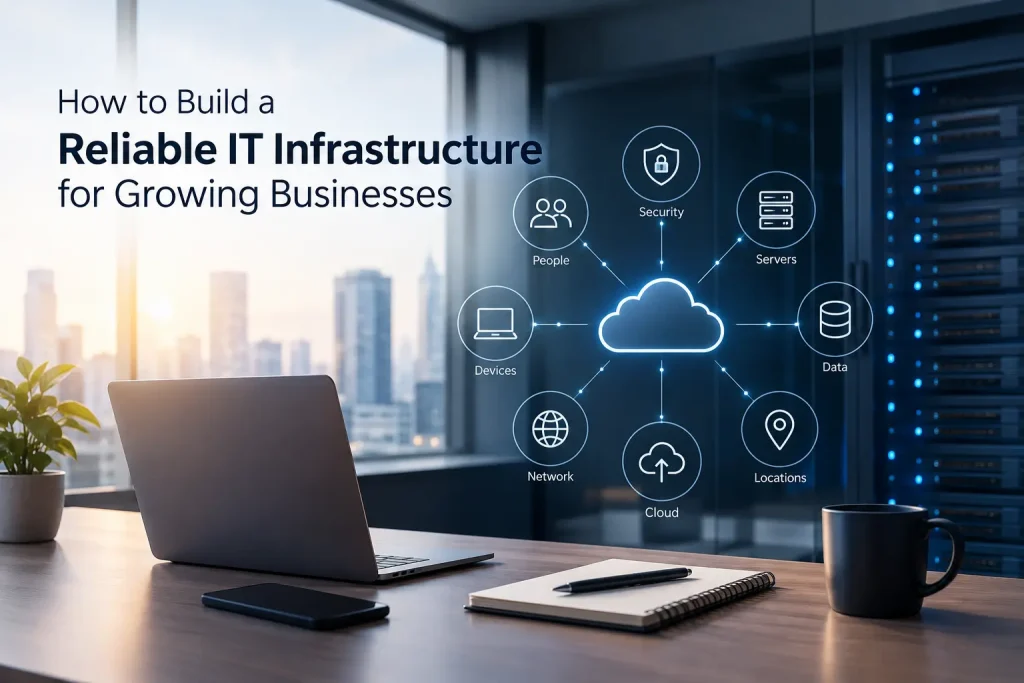
As a business grows, its technology requirements grow with it. A small company may initially operate with a few computers, basic networking equipment, cloud applications, and standard security tools. However, as the number of employees, customers, devices, applications, and locations increases, an informal technology setup can quickly become difficult to manage.
A reliable IT infrastructure provides the foundation businesses need to operate efficiently and securely. It connects employees, applications, data, devices, networks, and cloud services while helping organizations maintain productivity as they expand.
Building this infrastructure requires more than purchasing new hardware whenever the business needs it. Companies should develop a structured approach that considers performance, scalability, cybersecurity, connectivity, data protection, remote work, and ongoing maintenance.
Start With Business Requirements
The first step in building an effective infrastructure is understanding what the business actually needs.
Technology should support business objectives rather than exist independently from them. Before purchasing equipment or implementing new systems, management should identify the organization’s current challenges and expected growth.
Consider questions such as:
- How many employees currently use company technology?
- How quickly is the workforce expected to grow?
- Which applications are essential to daily operations?
- Does the company have remote or hybrid employees?
- How many offices or branches need to be connected?
- What types of information require protection?
- Which systems need to remain operational at all times?
The answers can help determine the appropriate infrastructure architecture.
A company expecting to double its workforce within a few years, for example, should avoid designing an infrastructure that only accommodates its current employee count.
Build a Reliable Network
The network is one of the most important components of modern business infrastructure.
Employees depend on network connectivity to access cloud applications, shared resources, communication platforms, business systems, and the internet. Slow or unreliable connectivity can quickly affect productivity across an organization.
A business network should therefore be designed around expected traffic, the number of connected devices, office size, applications, and future expansion.
Depending on the organization, the infrastructure may include switches, routers, wireless access points, firewalls, VPN connectivity, and network monitoring tools.
Businesses should also consider redundancy for critical network components. If an essential device fails and there is no backup or alternative connection, a relatively small hardware problem can become a major operational disruption.
Plan for Scalability
Infrastructure should be capable of growing alongside the business.
A company may begin with twenty employees and eventually grow to hundreds. It may also add new departments, offices, branches, applications, or cloud services.
Scalability should therefore be considered during the initial design.
This can involve selecting networking equipment with sufficient capacity, establishing structured IP addressing, using scalable cloud services, and creating standardized configurations.
Cloud-based solutions can also make expansion easier because businesses can increase certain resources without completely rebuilding their physical infrastructure.
The objective is not necessarily to purchase the largest possible infrastructure at the beginning. Instead, businesses should create a flexible foundation that can be expanded without excessive disruption or expense.
Make Cybersecurity Part of the Infrastructure
Cybersecurity should not be treated as something added after the infrastructure has been built.
As organizations become increasingly dependent on digital systems, protecting users, devices, applications, and data becomes a fundamental infrastructure requirement.
A modern security strategy should use multiple layers of protection. Firewalls, endpoint security, identity controls, access policies, network security, authentication, and monitoring can work together to reduce risk.
Identity security is particularly important because compromised credentials can provide attackers with access to business applications and data.
Multi-factor authentication can add another layer of verification beyond a username and password. This becomes especially valuable when employees access company systems remotely or use cloud-based applications.
Cisco Duo, for example, provides multi-factor authentication, single sign-on, device trust, and Zero Trust capabilities, while Cisco Umbrella provides cloud-delivered DNS-layer security designed to help protect users from malicious internet destinations.
Businesses looking to strengthen their network and security foundation can explore IT infrastructure solutions that combine infrastructure planning with appropriate security technologies.
Secure Remote and Hybrid Work
The traditional office perimeter has changed considerably.
Employees may work from home, customer locations, branch offices, hotels, or other remote environments. This means security controls cannot depend entirely on employees being connected to the corporate office network.
Businesses should ensure remote users can securely access the applications and information they need.
Identity verification, multi-factor authentication, secure remote access, endpoint security, and cloud-based security controls can help organizations extend protection beyond the physical office.
DNS-layer security can also provide protection for users outside the traditional corporate network. Cisco describes Umbrella as a cloud-delivered security service that can enforce security policies and protect users from internet-based threats regardless of location.
Protect Business Data
Data is one of an organization’s most valuable assets.
Customer records, financial information, employee details, contracts, intellectual property, project files, and operational information all need appropriate protection.
Businesses should establish clear policies governing where data is stored, who can access it, how it is shared, and how it is backed up.
Backups should be designed around the importance of the information being protected. Critical systems may require more frequent backups and stronger recovery capabilities than less important data.
Companies should also regularly test their backups. A backup that has never been tested may not provide reliable protection during an actual incident.
Establish Access Controls
Not every employee needs access to every system or piece of information.
Access should be based on job responsibilities. Employees should receive the permissions required to perform their work without automatically receiving unnecessary privileges.
This principle can reduce the potential impact of compromised accounts.
As the organization grows, manually managing permissions can become increasingly difficult. Businesses should therefore consider centralized identity and access management where appropriate.
Multi-factor authentication can provide an additional layer of protection by requiring users to verify their identity through more than one factor.
Standardize Devices and Software
A growing organization can quickly accumulate a mixture of computers, operating systems, applications, and configurations.
While flexibility can be useful, excessive variation makes IT management more difficult.
Standardizing hardware and software where practical can simplify:
- Device deployment
- Software installation
- Security updates
- Troubleshooting
- Employee onboarding
- Hardware replacement
- IT support
For example, establishing a small number of approved laptop and desktop configurations can make procurement and maintenance more predictable.
Standardization does not mean every employee must have identical equipment. Different departments can have different configurations while still following an established technology standard.
Implement Monitoring and Maintenance
A reliable infrastructure requires ongoing monitoring.
IT teams should be able to identify performance problems, unusual network activity, hardware failures, connectivity issues, and security events before they become major incidents.
Monitoring can provide visibility into infrastructure health and help IT teams respond proactively.
Routine maintenance is equally important. Operating systems, applications, firmware, security tools, and network equipment should be kept updated according to the organization’s policies.
Businesses should also maintain an inventory of hardware and software. Knowing which devices exist, who uses them, what software they run, and when they were purchased can make infrastructure management considerably easier.
Plan for Business Continuity
Even well-designed infrastructures can experience failures.
Power outages, hardware failures, cyber incidents, connectivity problems, natural disasters, and human errors can all interrupt operations.
A business continuity strategy should identify the systems that are most important to daily operations and establish procedures for maintaining or restoring them.
This may involve redundant internet connections, backup hardware, alternative communication methods, cloud-based applications, backup systems, and documented recovery procedures.
The key is to prepare before an incident occurs.
Think About Total Cost of Ownership
Infrastructure decisions should not be based solely on purchase price.
A cheaper device or security solution may appear attractive initially but could require more maintenance, provide limited scalability, or become obsolete quickly.
Businesses should consider the complete cost of ownership, including hardware, licensing, support, maintenance, upgrades, downtime, energy consumption, and eventual replacement.
Investing in dependable infrastructure can reduce operational disruptions and provide better long-term value.
Work With the Right Technology Partner
As infrastructure becomes more complex, businesses may benefit from working with an experienced technology partner.
A capable provider can help assess current systems, identify weaknesses, recommend appropriate technologies, implement infrastructure, configure security solutions, and provide ongoing technical support.
For growing businesses, this can be particularly valuable because infrastructure requirements change over time.
IJONA Technologies provides IT infrastructure services covering planning, deployment, management, and optimization, with solutions designed around performance, security, scalability, and business growth.
Final Thoughts
Building reliable IT infrastructure is a long-term process rather than a one-time technology purchase.
Growing businesses need systems that can support increasing numbers of employees, devices, applications, and locations without sacrificing security or performance. A strong foundation should include reliable networking, scalable systems, effective cybersecurity, data protection, remote-access capabilities, monitoring, and business continuity planning.
The most effective infrastructure is not necessarily the most complicated one. It is the infrastructure that supports the organization’s current requirements while providing enough flexibility to adapt to future changes.
By planning technology around business objectives and treating security, scalability, and reliability as core requirements, companies can create an IT environment that supports sustainable growth rather than becoming a limitation as the organization expands.